
Electric Underfloor Heating for Bathrooms: Mats, Thermostats and Real Running Costs
Heating mat or cable? How thick should the floor build-up be, which thermostat to pick and what electric underfloor heating in a bathroom really costs to run – an overview from a GWP Klima specialist in the Šumperk region.
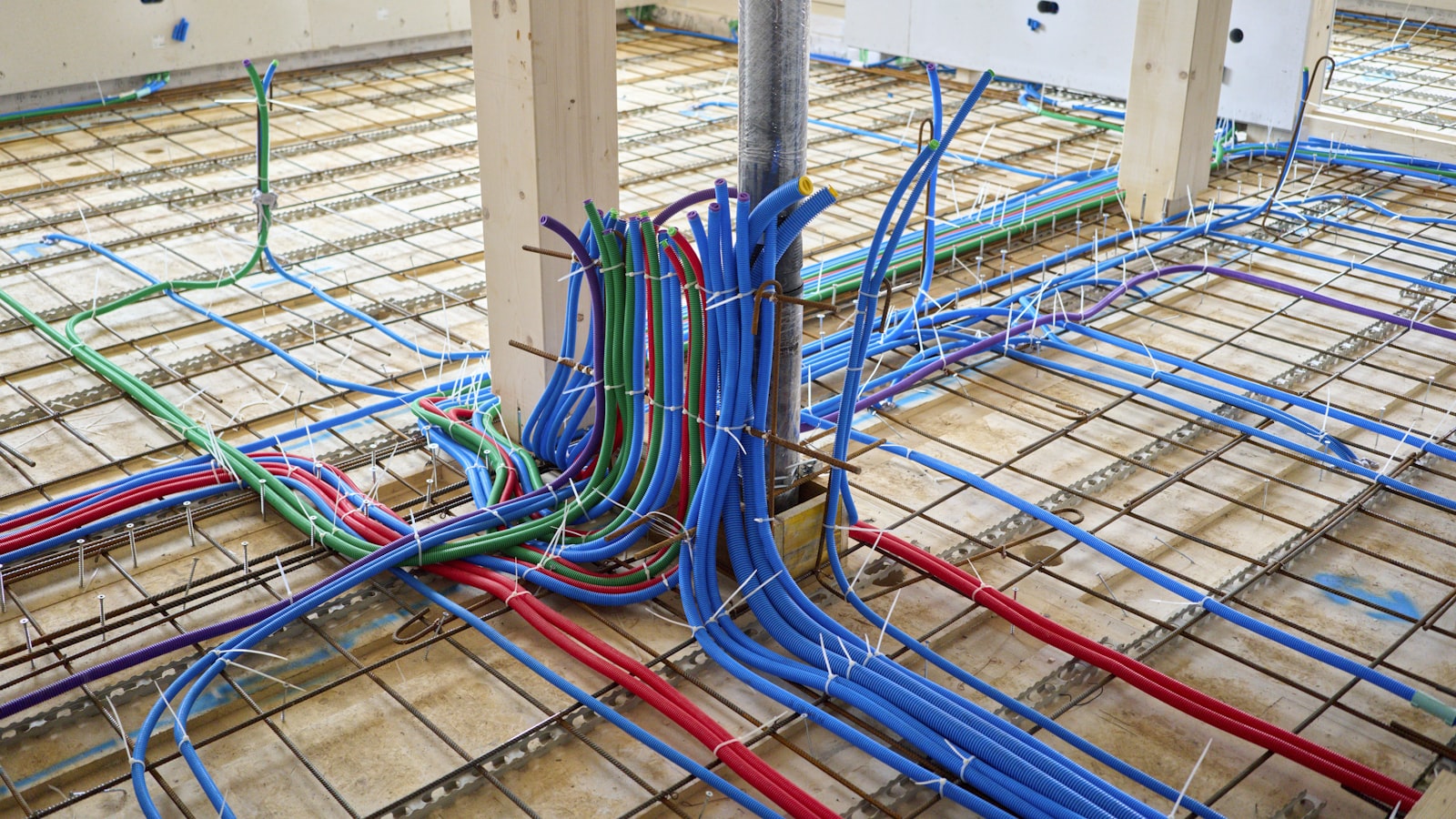
Electric underfloor heating in a bathroom is, in the vast majority of cases, handled with a heating mat under the tiles rated at around 160 W/m² together with a thermostat that has a floor sensor. In a typical bathroom of roughly 6 m² this corresponds to an installed power input of about 960 W and running costs of roughly 3 000–6 000 Kč a year if you only keep the floor warm (the thermostat then switches on for only about a quarter to two fifths of the heating season). At GWP Klima we have been installing electric underfloor heating in the Šumperk region and across the whole Olomouc Region for many years – below we explain when to choose a mat and when a cable, what a correct floor build-up should look like, why a smart thermostat pays off and what you will actually pay to run it.
Heating mat or loose heating cable?
The principle is the same for both – an electric resistance conductor that heats up and transfers heat into the floor. They differ, however, in form and in where they are best used:
- A heating mat is a heating cable with a fixed spacing (at least 30 mm) attached to a self-adhesive supporting mesh. It is laid simply by unrolling, delivers an even output per m², and the mesh can be cut and turned where needed, so you can work around fixtures and unusual room shapes. That is exactly why a mat is ideal for small and intricate areas such as a bathroom.
- With a loose heating cable you set the spacing yourself, so you can spread it evenly even over a very irregular floor plan. The drawback: the cable has a fixed resistance and output, and therefore cannot be shortened. It is better suited to thicker build-ups and as the main heating embedded in concrete or anhydrite screed.
In short: a mat is more expensive per metre but faster to lay and more precise on small bathroom areas; a cable embedded in anhydrite or concrete works out cheaper per metre and is used mainly as full underfloor heating for larger rooms. In a bathroom we therefore almost always reach for a mat under the tiles.
Floor build-up and its thickness
Depending on whether the floor is only to keep things warm or to heat at full power, we choose one of two build-ups.
Thin mat directly under the tiles
The most common solution for a bathroom. We set the mat into a thin layer of flexible adhesive right under the tiles, and the thermostat's floor sensor runs in a conduit (a so-called gooseneck) between the cable loops so it can be replaced in the future. The thin cable with a lower linear output heats the floor evenly and, above all, quickly – the build-up is only a few millimetres, so the floor responds within tens of minutes. That is exactly what you want in a bathroom: warm tiles in the morning, when you need them most.
Cable embedded in anhydrite (semi-storage mode)
If the floor is to serve as the main heat source, the cable or mat is embedded in a load-spreading layer. There should be at least 3.5–4 cm of anhydrite above the insulation, and in semi-storage mode the thickness of the load-spreading layer is around 45–55 mm. The build-up from bottom to top looks like this:
- concrete base,
- thermal insulation (so the heat travels up into the room, not down),
- heating mat or cable,
- anhydrite (or concrete) slab with the floor sensor,
- walking surface – the tiles.
A thicker build-up stores heat, so it can be cheaply topped up during the low tariff and the heat is released gradually. The price for this is a slower response and a greater build height – in a renovated bathroom there is often no room for it, which is why a thin mat is the usual choice there.
Thermostat and control – including WiFi
Control is what turns electric underfloor heating into a comfortable yet economical system. Without it you would heat "flat out" and wastefully. The standard is a thermostat with a floor sensor placed in a conduit; better models combine a floor and a room sensor so that the temperature matches both the tile surface and the air in the room.
Programmable and smart WiFi thermostats go a step further – you set time schedules (for example, warming the bathroom up by 6:30 before your morning shower) and, above all, they can heat preferentially during the low tariff. That is crucial with electric heating: consumption shifts into the cheaper hours and running costs drop noticeably. To control electric heating we also use the TREO H WiFi system, which lets you manage the temperature from your phone and keep an eye on your running costs.
Real consumption and costs of electric underfloor heating in a bathroom
The consumption of electric underfloor heating depends not so much on the type of mat as on the insulation of the building. The range is enormous – from roughly 15 kWh/m²/year in a passive house up to 200+ kWh/m²/year in an old, uninsulated property. As a general rule, electric underfloor heating makes sense as the main source where the heat demand is roughly up to 70 kWh/m²/year; above that threshold the bill rises quickly.
To give you an idea, here is a model bathroom example (illustrative, not measured):
- area ~6 m² × 160 W/m² ≈ 960 W installed power input;
- when keeping the floor warm, the thermostat switches on for roughly 25–40 % of the heating season → around 400–900 kWh/year;
- at an electricity price on the order of 7 Kč/kWh that comes to roughly 3 000–6 000 Kč per year.
Treat this as a rough estimate – the reality depends on insulation, the required temperature, the running time and the control. The price of electricity is also volatile: the final price on the standard D02d tariff in 2026 is around 6.5–7.5 Kč/kWh including distribution and VAT. If you heat the whole house with electricity, you usually have the D57d tariff with 20 hours of low tariff per day (the low-tariff rate is roughly 4 Kč/kWh) and then running costs work out significantly cheaper. In the Šumperk region the distributor is EG.D, so we always recommend checking the current price list directly with them.
Main heating or just keeping the floor warm?
This is the most important decision, and it affects both the build-up and the bill:
- Keeping the floor warm (most common in a bathroom): the floor is pleasantly warm underfoot and helps dry the tiles quickly, but the main heat is supplied by a radiator, a heated towel rail or another source. A thin mat under the tiles is enough, with low running costs and a fast response.
- Main heating: the floor covers the entire heat loss of the room. It requires good insulation, a higher output and usually a thicker build-up (cable in anhydrite). As full heating, electric underfloor heating pays off mainly in well-insulated buildings.
When designing the system we follow the rule that the installed power input should be roughly 1.1–1.3× the calculated heat loss. For a bathroom we commonly choose around 160 W/m² (special mats up to ~200 W/m²), for keeping hard floor coverings warm in other rooms 150–160 W/m², and for anhydrite in semi-storage mode 80–140 W/m². In a well-insulated house (direct heating) even ~40 W/m² is enough, and with average insulation 60–80 W/m².
What we watch out for during installation
Electric underfloor heating is reliable, but it does not forgive mistakes when laying it – once the cable is embedded in the floor you can no longer repair it. That is why we follow several principles:
- keep the heated area at least 5 cm from the walls;
- do not lay it under a bath, a shower enclosure or under furniture without legs – heat builds up beneath them and the cable can overheat;
- for rooms over 20 m² provide an expansion joint;
- respect the minimum bending radius of the cable (8× its diameter);
- run the floor sensor in a conduit so it can be replaced without demolition;
- always connect the 230 V supply via a residual-current device and by a person with electrical certification.
In a bathroom there are also stricter rules for the zones around the bath and shower, so we always lay out the mat in a way that ensures both the build-up and the protection rating match the wet environment.
We will help you with the design and installation
Electric underfloor heating in a bathroom is an investment you notice every morning on your bare feet – and when it is well designed and smartly controlled, it will not saddle you with high running costs. The key is to choose correctly between a mat and a cable, to design the build-up according to whether the floor is to keep things warm or to heat, and to add a thermostat that can work with the low tariff.
At GWP Klima we are a pair of specialists with more than ten years of experience; electric heating and heat recovery ventilation are my area in particular. We install in Bludov, Šumperk, Zábřeh, Mohelnice and around Jeseník, and across the whole Olomouc Region. Get in touch with us at +420 728 977 209 or [email protected] and we will arrange a no-obligation consultation – we will go through the layout of your bathroom, the insulation and what you expect from the floor, and propose a tailored solution.
Step-by-step guide
-
Designing the output and type of heating
We calculate the bathroom's heat loss and choose the output (commonly ~160 W/m² for a bathroom) and the type – usually a thin mat under the tiles. We set the installed power input at roughly 1.1–1.3× the calculated heat loss.
-
Preparing the base and insulation
We clean the base and, for build-ups intended as the main heating, add thermal insulation so the heat travels up into the room, not down into the ceiling below you.
-
Laying the mat
We unroll the mat at least 5 cm from the walls, away from the area under the bath, shower enclosure and furniture without legs. We cut and turn the mesh around obstacles as needed.
-
Fitting the floor sensor
We run the thermostat's sensor in a conduit (a gooseneck) between the cable loops so it can be replaced in the future without breaking up the floor.
-
Bedding in and laying the tiles
We bed the mat into a thin layer of flexible adhesive and lay the tiles, or for a thicker build-up we embed it in anhydrite (min. 3.5–4 cm above the insulation).
-
Wiring the thermostat and commissioning
We connect the thermostat (ideally WiFi with a floor sensor) via a residual-current device, set the time schedules and low-tariff use. We only switch the heating on once the adhesive or anhydrite has cured.