Heat Pump Service Before Winter: What to Check and Why
A pre-season service of your air-to-water heat pump determines how efficiently you'll heat all winter. We'll explain what the inspection covers, what you can do yourself, what belongs to a professional, and when to book it.
An air-to-water heat pump heats efficiently only if it goes into winter with a clean evaporator, the right pressure in the heating circuit, and properly tuned controls. That is why we recommend booking your pre-season heat pump service for late summer or early autumn, ideally in September or October, before the first frosts arrive. A neglected unit with a clogged evaporator or a poorly set weather-compensation curve can, in practice, run at a real-world coefficient of performance (COP) of around 2.5 instead of 4 or more, and that shows up immediately on your winter electricity bill.
Why a Heat Pump Needs Annual Service
With a heat pump, the "if it works, don't touch it" logic doesn't apply. It runs practically non-stop throughout the entire heating season, and a little neglect shows up in three ways that make regular heat pump maintenance worthwhile:
- Efficiency and running costs. The catalogue seasonal coefficient of performance (SCOP) of modern air-to-water heat pumps typically ranges between 3.3 and 4.5 (top models reach around 5). But with a clogged evaporator, incorrect refrigerant pressure, or a badly set temperature differential, real-world efficiency can drop as low as 2.5–3. At a low-tariff price of around 4 CZK/kWh, 1 kWh of heat works out at roughly 1.1–1.2 CZK, so every tenth of a point in the COP adds up to thousands of crowns over a winter.
- Warranty. Most manufacturers tie their extended warranty to a documented annual inspection carried out by a professional company. Without a maintenance record, the cost of replacing an expensive component can fall on you.
- Service life. The compressor and the circulation pump are the most expensive parts of the whole system. A clean evaporator, the correct flow of heating water, and a tightness check of the refrigerant circuit significantly reduce their wear and the risk of a breakdown in the middle of a cold snap, when a repair is least welcome.
What a Pre-Season Heat Pump Service Includes
A complete heat pump service for an air-to-water unit has two sides: the outdoor unit, which works with the ambient air and refrigerant, and the indoor part with the heating circuit and controls. We'll go through both.
The Outdoor Unit: Evaporator, Fins, and Condensate
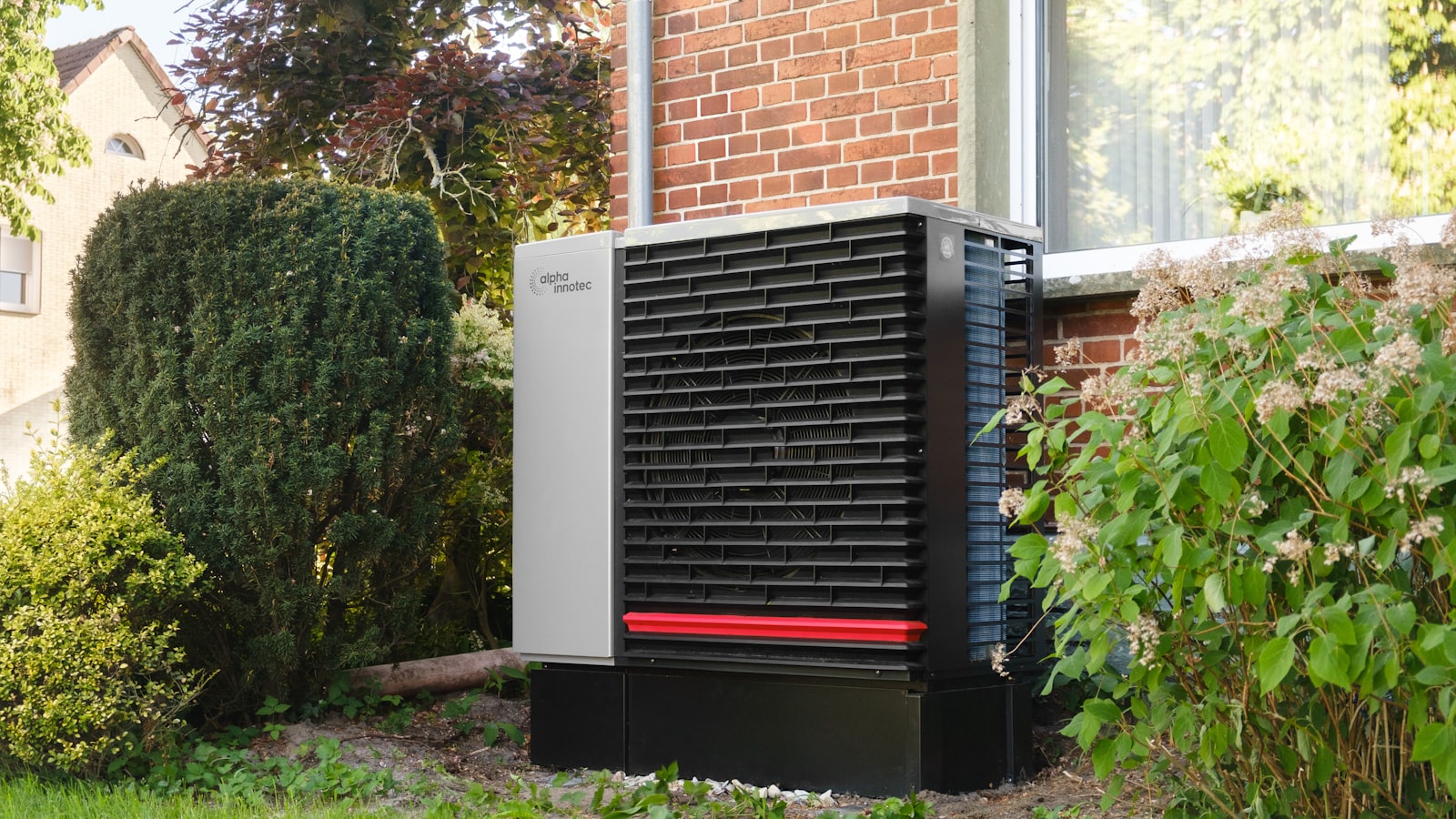
The finned heat exchanger (evaporator) of the outdoor unit draws heat from the ambient air, and a huge amount of air and dirt passes through it over a season. Leaves, cut grass, dust, and cobwebs between the fins reduce airflow and, with it, output and efficiency. The service includes:
- gentle cleaning of the evaporator fins and removal of debris from inside the unit,
- a check of free condensate drainage from beneath the unit, so that in freezing weather it doesn't form a block of ice under the pump that jams the fan,
- verification of the defrost cycle – in low temperatures and humidity the evaporator ices up and the unit briefly switches to reverse operation to melt the frost; if the cycle doesn't work properly, the pump "freezes up" and loses output,
- a check of the mounting, anti-vibration elements, and the condition of the fan.
In the Šumperk area and the foothills of the Jeseníky Mountains, where frost and damp arrive earlier than in the lowlands, a properly functioning defrost and free condensate drainage are especially important.
The Heating Circuit: Pressure, Circulation Pump, and Filter
The indoor side distributes heat through the heating system. Here we check:
- the pressure in the heating system on the gauge and the condition of the expansion vessel – low pressure means air in the system, noisy operation, and poorer heat transfer,
- the circulation pump and the flow of heating water (poor flow drags down the real-world COP),
- the filter / dirt separator (magnetic filter) on the circuit, which catches sludge and metal particles; a clogged filter throttles the flow just like a blocked drain,
- for systems with antifreeze, a check of the concentration and condition of the fluid.
Refrigerant and Wiring: a Job for a Professional
Checking the pressure and tightness of the refrigerant circuit, as well as inspecting the electrical wiring, belongs exclusively in the hands of a company licensed to work with refrigerants (F-gases). This is required not only for safety but also by law. Older units often run on R-410A refrigerant, which is now more expensive and harder to obtain due to the European phase-down of fluorinated gases, so any leak and the subsequent top-up becomes noticeably more expensive. At the same time, operating and servicing existing units with R-410A or the more modern R-32 remains entirely legal. All the more reason to check tightness every year, while any leak is still small.
Control Settings and the Weather-Compensation Curve
The most common silent drain on your savings isn't a mechanical fault but a poorly set weather-compensation (heating) curve. When the pump needlessly heats water hotter than the house needs, it costs more to run. During the service we therefore tune the heating curve to the actual system, check the operation of the time programmes and the use of the low tariff (the D57d distribution rate now offers 20 hours of low tariff per day), and verify the correct temperature differential.
What the Owner Can Do and What Belongs to a Professional
Every owner can handle part of the pre-season check, and it's worth doing regularly. Without any tools, and at no risk, you can:
- keep the space around the outdoor unit clear (leaves, snow, vegetation),
- visually check that nothing is blocking the air intake and outlet,
- verify that the condensate drain is neither clogged nor frozen,
- watch the pressure on the gauge and listen for any new, unusual noises from the unit.
Conversely, always leave to a professional any work involving refrigerant and pressure, pressure-cleaning of the heat exchanger, inspection of the wiring, the expansion vessel check, and tuning of the controls – that is, the tasks where amateur intervention risks damaging the unit or voiding the warranty.
A practical tip from the field: most of our January call-outs are to pumps that no one has looked at since installation. The vast majority of these "faults" are a clogged condensate drain, a fouled evaporator, or a heating curve that has drifted out of tune – exactly what a pre-season inspection reveals before the problem arises.
When to Book the Service
The ideal time is late summer to early autumn, in practice September and October. The unit is still accessible, isn't buried under snow, and you have time to order any spare part well ahead of the heating season. Booking the service only when the pump cuts out in the cold means waiting during the busiest time of the year. If you haven't managed the inspection yet this year, it isn't too late – the check can be done in winter too; it's just best not to put it off.
At GWP Klima, we are two specialists with more than ten years of experience, and we service heat pumps throughout the Šumperk area and the Olomouc Region – Šumperk, Zábřeh, Mohelnice, Jeseník, Rapotín, Bludov, and the surrounding area. If you aren't sure when your pump was last tuned, or you're wondering why it costs more to run in winter than it used to, get in touch for a no-obligation consultation. We'll be glad to look at your installation and propose a maintenance plan tailored to it.
Step-by-step guide
-
Clear the area around the outdoor unit
Remove leaves, cut grass, snow, and vegetation from the space around the unit. Check that nothing obstructs the free intake and outlet of air through the evaporator fins.
-
Check the condensate drainage
Make sure the condensate drains freely from beneath the outdoor unit and that no block of ice forms under it. A clogged or frozen drain is the most common cause of problems in winter.
-
Verify the pressure in the heating circuit
Look at the pressure gauge on the indoor unit. If the pressure has dropped significantly below the recommended value, there is air in the system and it should be topped up and bled – or call a professional.
-
Listen to the operation and watch the defrost
While it runs, watch for any new, unusual noises and check that the short defrost cycles take place and that the pump then returns to heating. Report any vibration or grinding to your service company.
-
Check the control settings
Verify the time programmes and the heating-curve settings. If the pump costs more to run than before or overheats, have the weather-compensation curve re-tuned to the actual needs of the house.
-
Book a professional pre-season inspection
Entrust work with the refrigerant, cleaning of the heat exchanger, inspection of the wiring, and tuning of the controls to a company licensed for F-gases. The ideal time is September to October, before the first frosts.